QuicSnap → Shutter Labs — AI product photography, racing the model curve
I built an AI product-photography business to real revenue, then pivoted to a platform ahead of the frontier models — and learned exactly how fast the curve moves.
- Role
- Co-founder. I owned strategy, pricing, GTM, fundraising, and the product decisions. My cofounders owned the research and engineering.
- Timeline
- May 2023 – Nov 2024
- Status
- Wound down — the frontier models shipped the capability we sold.
- Team
- Built it twice — production artists and art directors for the service, then two technical cofounders and a small GTM team for the platform.
- Numbers
- ~$85K revenue
- Tech
- Fine-tuned diffusion models · LoRAs · depth maps · NeRFs · the 3D-to-diffusion stack.
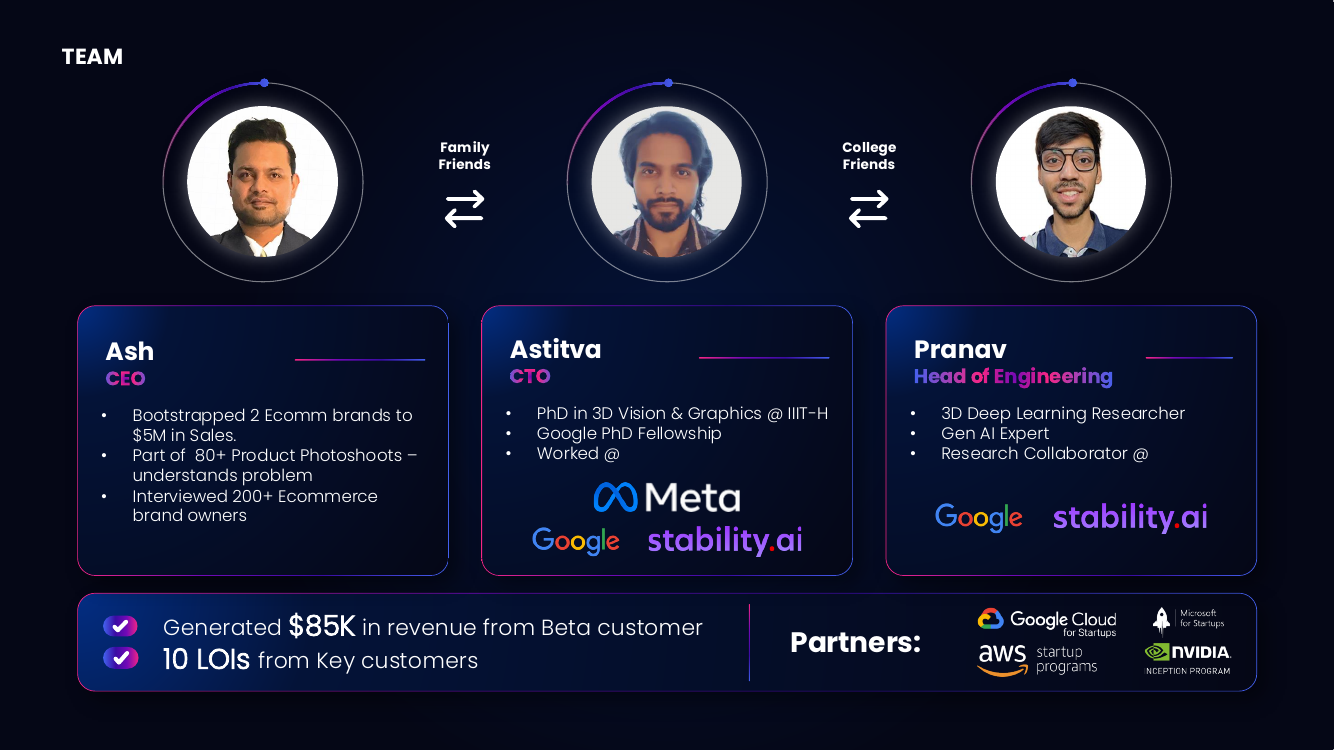
For about eighteen months I chased one stubborn problem in ecommerce: photorealistic product imagery that keeps the exact fine print on the product — the label text, the logo, the regulatory small print. I solved it first with people, then with software. The service made real money, roughly $85K bootstrapped. The part I'm actually proud of, though, is the call I made next: I could see the frontier image models coming for the exact thing we charged for, so I pivoted the company to get ahead of them — before that capability turned into an API call.
Build the team, sell the pixels
The idea
I came to this as a customer. Running my own ecommerce brands, I sat through 80+ product photoshoots — book a studio, ship the product, wait weeks, get images that miss the brief, then grind through revisions. QuicSnap was the productized fix: send images of your product, and a team I built from scratch — production artists, art directors, an offshore 3D pipeline — delivers photorealistic listing imagery without a studio. Fixed prices, an art director on every order, unlimited revisions.
Why humans were load-bearing
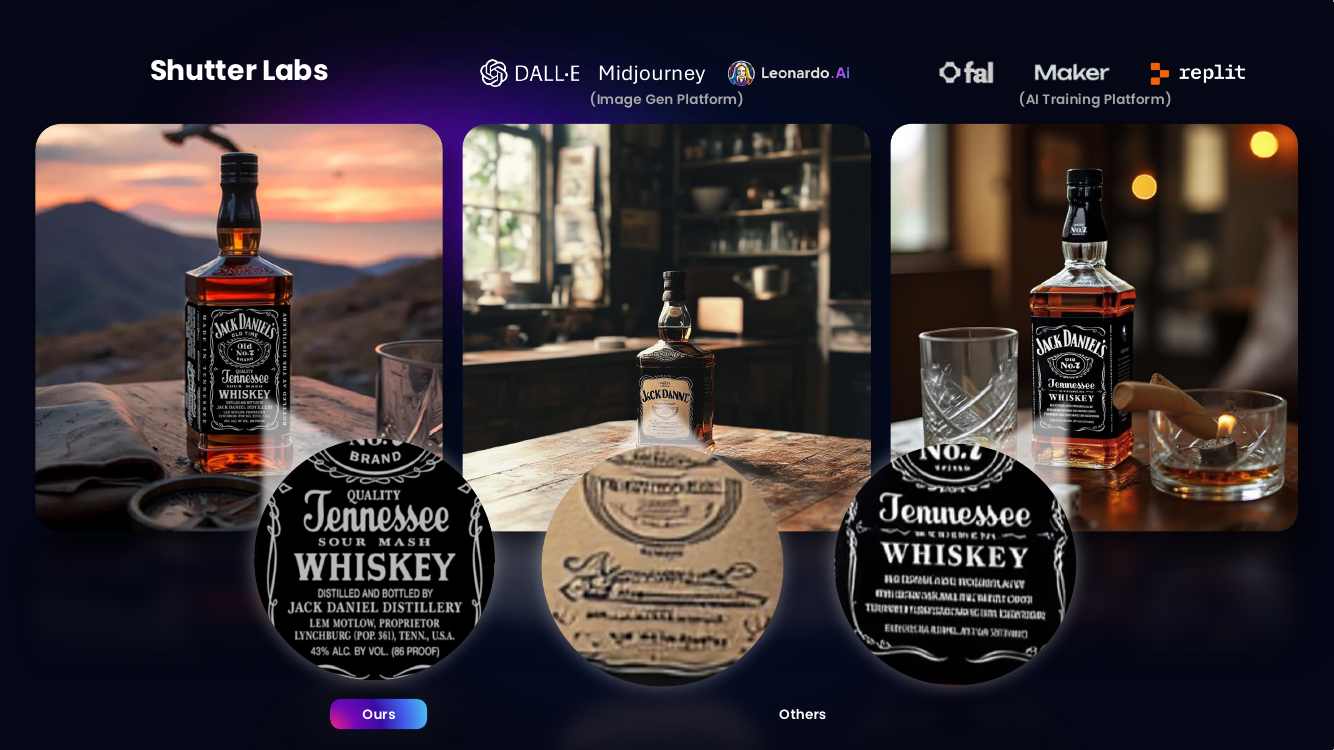
We were an AI company from day one, so why the people? Because most of our clients were FMCG and personal-care brands, and for them *the label is the product* — ingredient lists, dosage text, regulatory fine print. That was exactly what image models mangled, and an image with garbled label text isn't 90% right, it's unusable. So we split the job:
- Model the product in 3D by hand (Blender) — geometry, label art, materials, exactly right.
- Generate everything around it with AI — scenes, lighting, indoor and outdoor sets, models in the frame.
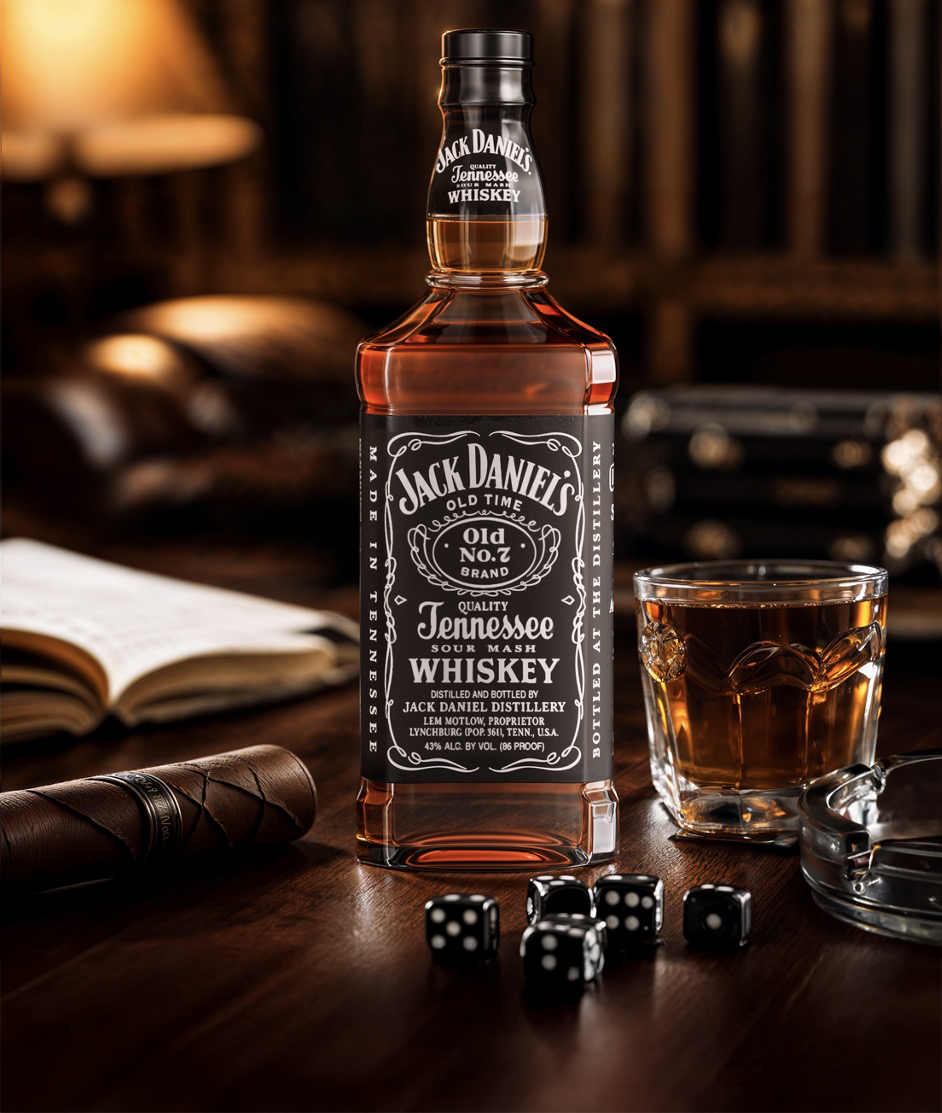
The hallucination-prone part was handled deterministically; the expensive part of a real photoshoot — the set, the props, the talent — was handled generatively. That split was the company.
How we found customers
Demand didn't walk in the door; I built the outbound engine. Vetted prospects from Apollo, a research step so every first email opened with something specific and true about that brand instead of a mail-merge token, and tooling to keep deliverability high across warmed domains. It's still the cleanest go-to-market system I've built.
What the money looked like
The chart stops in April 2024 because that's where this chapter stops. Rather than grind out more flat months, I stopped selling artist-hours and pivoted the company to Shutter Labs — the same fidelity promise, rebuilt as a platform the customer drives. The rest of this story is that bet.
The bet I updated in public
Then the image models started getting dramatically better, fast — each release rendered text noticeably cleaner than the one before. That didn't disprove our founding assumption — models mangle fine print, so our humans-plus-3D pipeline exists. It did something worse: it put an expiry date on it. If what you sell is a workaround for a model limitation, model progress is a countdown clock.
So I made the call: stop selling the workaround, start selling the workflow. The service was still making money when I shut it down and pivoted from a model where we do everything to a platform where the customer does it themselves — and I wanted to be there before the capability became a commodity. Two months earlier I had written “AI alone isn't possible with today's tech” in our own executive summary. Changing your mind in public, with your team's paychecks riding on the old position, is harder than any deck makes it look.
What we built
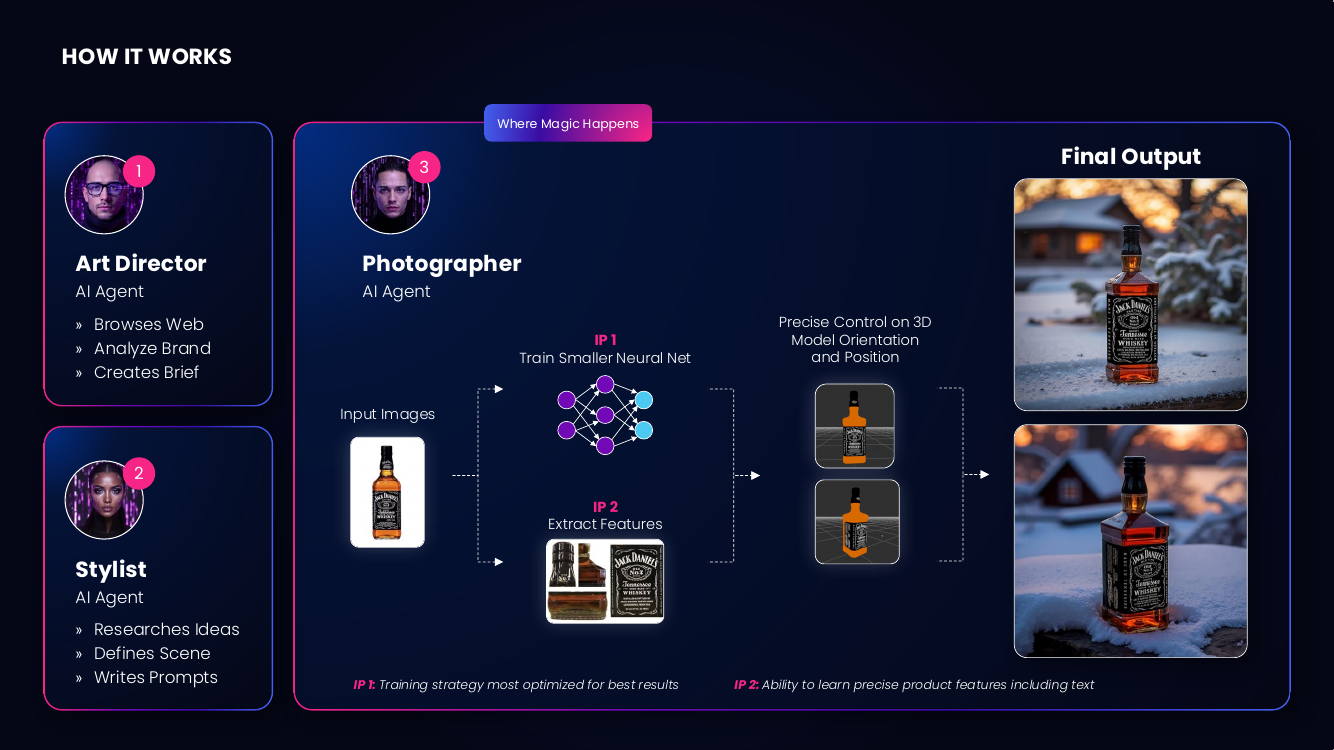
Two pillars, both aimed at the fidelity problem we used to solve by hand:
- 2D→3D product capture. Upload a few photos and reconstruct a 3D asset — Gaussian splatting, monocular depth estimation, NeRFs, Open3D for geometry. What our Blender artists did by hand, automated at intake — and the user gets full 3D control: rotate the product, place it, set the camera.
- Product-specific LoRAs. A fine-tune per handful of SKUs whose only job was to lock the fine print — label text, logos, materials — while the base model generated everything else.
Selling to a Fortune 500 with no leverage
The strongest validation of the work arrived inbound: a Fortune 500 retailer, impressed by what we were shipping, approached us and engaged us for a paid POC. An account that size was far above our weight class. We delivered the POC anyway, presented the results, and finished as one of the finalists in their evaluation.
Then they shelved the project — no rejection, no green light, just a pause that never ended. I refused to let it die quietly and tried every play I knew to restart it. We priced their build-in-house option against our managed service, using their own numbers. When procurement pushed back, I restructured the deal instead of cutting the price: a volume ladder, a de-risked entry, image ownership conceded, responsibilities split line by line. An earlier deal had taught me that the hard way, after I'd chained discounts down to near-zero margin just to land a logo — this time I changed the deal's shape, not just its number. It still didn't close. Some deals die of no decision, and this one did — but I'd rather lose an account being flexible on structure than desperate on price.
The models caught up
While we were still building, Nano Banana Pro launched — and it could simply generate and render all the text: ingredient lists, logos, label typography, directly out of the model, no 3D reconstruction, no per-product fine-tune. The exact capability we'd built the company to guarantee was now a default setting. That was it. We lost momentum, and the company died.
What I actually learned
1. AI moves in bulk — be ready to catch the jumps.
The capability curve isn't smooth. It moves in bulk: a big leap, then a plateau where little changes, then another leap. The edge doesn't go to whoever predicts the exact date — it goes to whoever is set up to ship the moment the curve lurches. Build so that a sudden jump is a tailwind you can catch, not a wave that lands on you.
2. Build on the overhang — and own something the next model can't.
There's an enormous overhang in these models — things they can almost do, rough edges nobody has smoothed yet. That's where the opportunity is: find the rough edges and build on top of them. But a capability edge alone is rented. To keep it, you have to accumulate something the next release can't hand out for free — memory and data of your own customers, aggregated over time. Without that, the next model eats your moat. So work on genuinely hard problems: if you win, you win big; if you lose, you learn big. I lost this one, and I learned a lot — image generation, denoising, LoRAs, depth maps, NeRFs, the whole 3D-to-diffusion stack. That knowledge keeps compounding even though the company didn't.
3. Losing to the curve doesn't mean the read was wrong.
The pivot thesis — customers will self-serve once fidelity is solved — was right. It's exactly what they do now; they just don't need us to do it. Everything I've built since Canvas sits on top of frontier models instead of against them — and the model class that ended Shutter Labs is now a line item in its pricing table. Same read of the curve, opposite side of the trade.